Thursday, March 26, 2015

This is Huge

Jo stands at the entrance to the Mammoth dig site to give perspective to the massive Mammoth. The bull stands 14 feet high at the shoulder. His bones are in the foreground.
In 1978, two young men were looking for arrowheads in a ravine near the Bosque River in Waco, Texas. Instead, they stumbled on a lost world of Mammoth bones.

The men took one of the bones they found to Baylor University in the city and that resulted in a dig that went on for 10 years and uncovered a huge family of Mammoths, bulls, females and babies who had died in the mud by the river.

As the scientists gingerly chipped away at the remaining soil, they also uncovered a North American Camel – this is the fore-runner of the camels that currently wander the deserts of Africa and the Middle East. They are bigger than the modern camel but our guide, Eva, told us scientists believe they had made their way across the land-ice bridge to Asia. The diggers also uncovered a saber-toothed cat and numerous other creatures.

But back to our amazing Mammoths. These boys were spectacularly large – much larger than the African and Asian elephants that we know today.  A full-size painting of one is at the entrance to the dig and he stands 14 feet to the shoulder. The biggest tusks found at the site are 16 feet long and curly at the end.

These Mammoths lived 68,000 years ago and were grass eaters. They lived during the Ice Age. Waco, during that time, was south of the ice and our guide told us it was rolling grasslands with trees near the sides of rivers.  

Their molars were massive things – about the size of shoeboxes. Just as today’s elephants come to the end of their lives when they lose their molars and can no longer chew their food, the Mammoths suffered from the same process. They had six sets of molars to last their lifetime, Eva told us. And when the last set ground down to nubs, the Mammoths were around 80 years of age.

Based on studies of their close relatives, the modern elephants, mammoths probably had a gestation period of 22 months, resulting in a single calf being born. Their social structure was probably the same as that of African and Asian elephants, with females living in herds headed by a matriarch, whilst bulls lived solitary lives or formed loose groups after sexual maturity.

No one yet is able to explain why these creatures became extinct 10,000 years ago. Global warming is thought to be possible. But the development of men and their killing tools might also be a possible reason.

The dig has run out of money, so the bones still lie in the dirt. I asked Eva if there was any thought given (remember, we are in Texas and you don't mess with Texas) to asking the federal government to declare this a national historic site. She told me a team from the university and the city of Waco went to Washington last month to make such a pitch.

It is tragic, to us, that we were the only people at the dig - mostly because no-one really knows about this treasure. But now you know.
 
The head, tusks and shoulders of the bull Mammoth lie in the dirt at Waco dig.


Saturday, March 21, 2015

Taking the Road Less Traveled

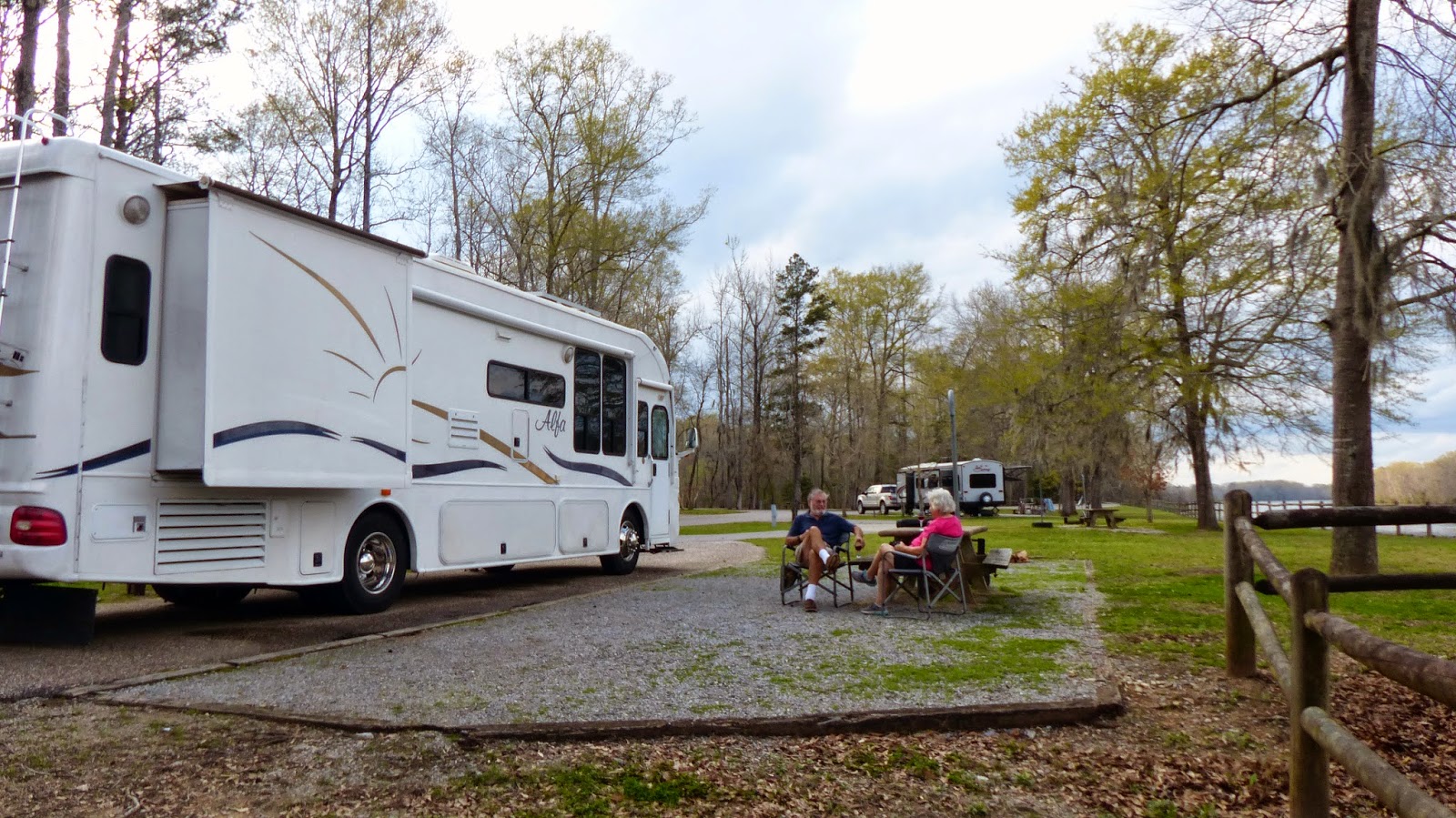
Living large. A glass of wine on the banks of the Tombigbee River in Alabama

Robert Frost, the Vermont poet, wrote:

“Two roads diverged in a wood, and I –
I took the one less traveled by,
And that has made all the difference.”

We did the same when we came to Tallahassee, the capital of Florida. We still were on the interstate which travels east-to-west across the top of Florida. It is a real eye-opener every time we’ve taken this road. When you leave Interstate 75 and take I-10, the mileage marker informs you that Pensacola, on Florida’s western tip of the panhandle, is 300 miles away. We had stopped in Tallahassee in a Walmart parking lot. Now we were ready to edge our way off the interstate and cross into Alabama.

The time change to Central Time also throws the traveler off on this stretch of road. But then Frost’s words settled into my consciousness and we began to feel the difference. Alabama is beautiful at this moment in the spring. Redbud trees are in full bloom – even a smattering of forsythia. There are few towns on the southern edge of the state -  just a tumbledown jumble of tired old houses that have seen much better days.

But there is sweetness to the place and there’s history. What is the story, I wondered, when we drove across a little bridge over Murder Creek? Another four miles up the road we came to Burnt Corn Creek. Jo was driving at the time which gave me the time to allow my mind and imagination to wander. Were these two creeks linked in history? We’ll never know, of course, but I surmise that the burning of the corn resulted in the murder. Maybe it was the other way around: The boys committed the murder and then rode up to the corn crib and set it afire.

We were heading for Coffeeville, Alabama, where we knew we’d find an Army Corps of Engineers campground. These are national treasures – particularly if you are older than 62. Half-price admission for the old folks if you carry an “America the Beautiful” Pass. And why wouldn’t you. It costs us $10 for life and it allows free entry to National Parks as well as half-price camping at Corps of Engineers campgrounds.

We arrived in mid-afternoon and Mary, our campground host, welcomed us and told us we had chosen a less desirable slot for our motorhome. “You want a pull-through parking spot along the water so you can watch the river traffic,” she told me in a musical, but thick, Alabama accent, I had chosen a slot on the back side of the campground when I booked via the internet. So she reassigned us to the riverfront. There were only two other rigs in the campground because it’s pretty early in the season. 

Warblers chattered away in the just-budding sycamore trees while cormorants flew upriver in great squadrons. Heavy tugs shoved their cargo up the Tombigbee River. This massive inland waterway connects the Tennessee and Mississippi rivers with the Alabama River and, eventually the Gulf of Mexico.

After we were settled, we were visited by Don, another volunteer host. He lives in a round tent and was blowing sycamore seedpods off the road. Don told us he had hiked the Appalachian Trail, south to north over a period of two years. He’s in his mid-seventies and looked pretty fit.

Tiny bug sits up a Corps of Engineers Witness Post.
We loved the campground’s peacefulness and decided to stay an additional night. This allowed time for exploring the trails and making a run by car to Coffeeville to purchase new cat food. Our cats had decided the Rachel Ray special food was no longer satisfactory and both spent time horking it up. Because it was a new bag, we figured there was something in the contents that had been changed. There’s only a single store at the crossroads and the choices were pretty limited. But they’re now enjoying their Purina chow.

We checked the weather on our iPad and decided to push on to Jackson, Mississippi, on Saturday. The rain caught up with us as we climbed farther north and we pulled into a parking lot on the south side of the city.

Jackson is the capitol of the state. Back in the early 1800s, when surveyors were dispatched to find a suitable site for the capital, they were urged to find something in the center of the state. That didn’t work out, however, because the center is a swamp. Jackson was chosen because it’s on the Pearl River and it was a transportation hub.

We came in with a quote. Let’s leave in the same way. Bob Dylan wrote this in Outlaw Blues in 1972:

“I got a woman in Jackson
I ain't gonna say her name
I've got a woman in Jackson
I ain't gonna say her name

She's a
Brown-skin woman
But I
I love her just the same
.” 

Saturday, March 14, 2015

Now, We Begin Again

These intaglios were unknown to western man for hundreds of years because it was impossible to "see" them from ground level. They're near Blythe, CA.
The question before us is quite simple: Can we cross America aboard our 37-foot motorhome and keep our living expenses below $250 a month. By living expenses, I mean our overnight campground costs. Usual campground costs range, for us, between $19 and $35 per night. They can go as high as $100 a night but you’ll never find us spending that kind of money. Seems pretty tight, I know. But Jo and I think we can do this. Anyway, we plan to give it a go.


How can we accomplish such a feat? We installed four large solar panels on the roof of our rig. They have the capability to generate 960 watts of electricity – and that should provide us with enough power to maintain the quality of our lives for multiple days between running the engine on the coach. In addition, we do have a pretty hefty diesel generator which we will try not to use. Its purpose is to provide enough energy to allow us to operate our air conditioner in the event the weather gets a little too warm. 
The solar installation was accomplished over a period of three days at Tarpon Springs, FL. We moved into the side yard at Hotwire Enterprises. The owner of Hotwire is John Gambill, a long-time sailor who has swallowed the anchor (as we sailors call it) and set up shop to sell the KISS (Keep It Simple Stupid) wind generator to sailors and an occasional motor-boater.
We set out on a journey to the west from our current base at Honeymoon Island State Park on the west coast of Florida. Current plans are to journey to Choudrant, LA, where we’ll stop for a couple of days to have our ac/heat pump serviced, along with replacing the seals on both our slides aboard the motorhome. The mechanic there has expertise specifically in the Alfa motorhome that we own.
Then we’ll wander westward across 1,000 miles of Texas, New Mexico and Arizona. We’ll linger for around 10 days in Arizona, attending a rally for owners of Alfa Motorhomes.  This should be our most expensive stop since we are all together in an RV resort and have to pay for the privilege.
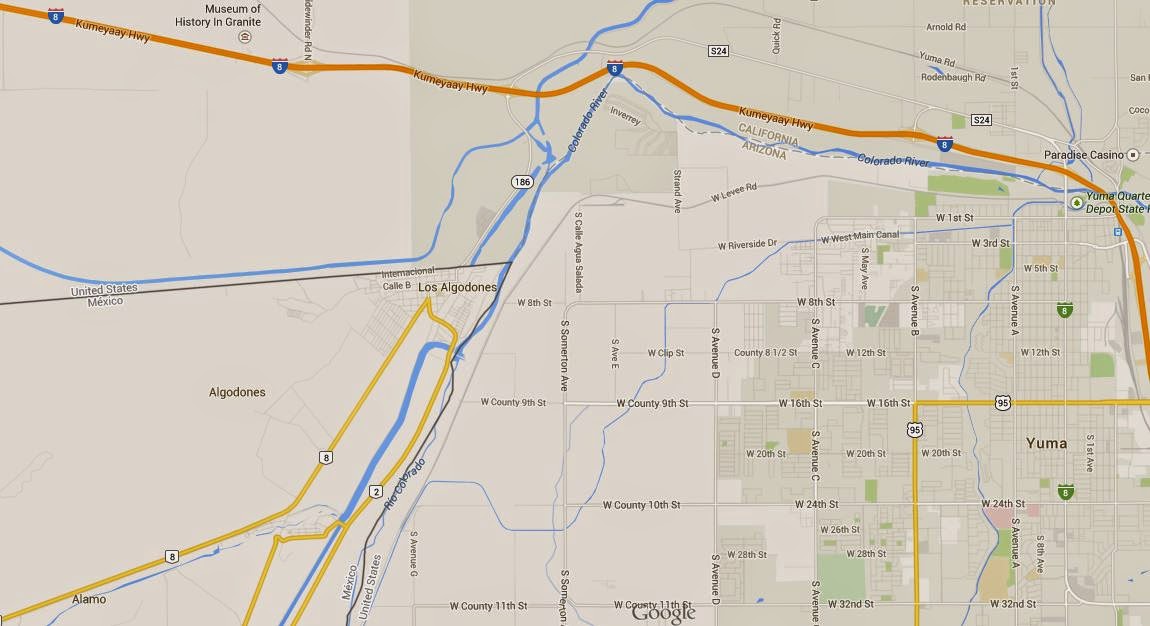
Then we’ll roll farther west to stop off in Mexico for a day or so for dental work in the little town of Los Algonodes before heading on to California, turning right and heading for Nevada, Arizona again, Colorado, Utah, Wyoming and South Dakota. We’ll roll eastward, eventually coming to Ohio, then Michigan and cross over to Canada. Eventually we’ll end up in Vermont before sliding south through Massachusetts, with a side trip to New Hampshire, then on to Connecticut. 
We hope you’ll come along vicariously on our journey as we drive approximately 8,000 miles in the coming six months. We’ll be stopping off at some of the natural wonders of this country – like the Grand Canyon, Hoover Dam, Yellowstone National Park, Devil’s Tower in Wyoming. But we’ll be taking the side roads to wondrous and mostly unknown treasures along the way – like the moving rocks of the Death Valley, or the 250-feet-long intaglios, created by Native Americans, that can only be seen from the air, near Blythe, CA. We’re looking forward to the grandeur of Monument Valley on the border between Arizona and Utah, as well as The Wave also between Arizona and Utah.
We can fit an unknown number of fellow travelers in the basement of our motorhome…so there’s room for everyone!
The Wave is hard to get to...but worth the hike...so we will get there!

Friday, February 20, 2015

All Power to the Sun

Louie screws the cables into the roof in front of two of the solar panels.

We have, at long last, made the move to solar power aboard our motorhome. It’s been two years of planning and learning. But the install is over now and we're amazed at how well this is working.

Yesterday, our first day back at Honeymoon Island State Park, we unplugged from shore power. I switched on the 2400-watt inverter that’s built into our motorhome. Voila! Everything lit up and we continued as normal. The crockpot continued to cook away, the lights continued to work. The TV functioned as it usually does.

We have a handy-dandy meter built into the front of our rig now. Its task is to measure the demand on the electrical system and it also measures the solar panels on the roof and their ability to meet that demand. If they are not able to meet the demand, the meter tells me I’m in negative mode and the power I need is pulled from the six 6-volt batteries I have at the front of the motorhome. If demand is being met by the sun, the meter tells me that, too, and the power simply passes from the solar panels to the control unit, then to the batteries and back through the inverter.

I can flip through the various screens and see all kinds of information about what’s happening in the batteries. All day, I was pretty much glued to this meter to see cause and effect. When I turned on the microwave oven, for example, the power demand was very high. The microwave demanded 90 amps from the solar panels. And the panels silently met that demand because we had clear skies all day. Later in the day, I plugged in the kettle to make tea. The meter showed that I was demanding 72.5 amps from the solar panels. And they delivered.

Our system has the ability to deliver 960 watts of power at a maximum of 160 amps. It was heartening, even exciting, to see how well the sun met our needs as if by magic.
When I flipped the switch to turn on the electric water heater, however, nothing changed on the meter. That told me, immediately, that the inverter has not been wired to allow the hot water tank to be used through the inverter. We have a nifty work-around for that, however. The hot water heater can be powered by electricity or by propane gas when you are camping away from electricity. Likewise, the refrigerator does not use the inverter to make 110 volts of AC to run that. Instead, its brain knows when it is not plugged into shore power that it should switch automatically to propane for its source of power.

There are four solar panels on the roof of our coach. Each one is designed to produce 240 watts of power. All of these are tied together and then the wires come together in a combiner box at the front of our coach. This is where a pair of heavy-duty wires come through the roof and was snaked down the frame of the coach alongside the windshield. They then were routed to a compartment under the driver where they are plugged into a solar controller. This is the device that is super smart and is able to understand what’s coming in from the solar panels and then it converts all this raw energy into 12-volt power that is usable by the batteries and the inverter in the coach. Lots of wiring, to make all of this work. It was ‘way beyond my electrical knowledge or comfort zone. 

That’s where Hotwire Enterprises came in. They are located 12 miles north of us in the little Greek town of Tarpon Springs. John Gambill, a retired sailor, runs the place and he was the brain behind making this wiring work.

He subcontracted much of the electrical work out to Louie, a marine electrician, who is a master of 12-volt systems. Louie is a transplanted New Yorker who is a master craftsman. He was fastidious and careful about every connection and every wire.

Now, we will test out our six batteries in the next few weeks to see that they are up to handling the activity. We think the batteries might be original to the 10-year-old coach so it is possible we’ll have to install new ones if they don’t have the necessary holding power. In the meantime, watching my meter is more fun than watching TV!


The dash of the motorhome can be lifted to allow access to all of the fuses.

Tuesday, December 9, 2014

Coming to America...Today

The Cubans were landing as I came along the beach and I got to be the first American to welcome them to these shores.

The time was 7:36 a.m. I’d just met Tony, the new Park Manager, on his first day at Fort Zachary Taylor. I came around the bathhouse at the concession stand and the sun had just cracked above the horizon. Good mood. Wonderful new day.

And, because I was happy, I was playing my music on my iPhone. Neil Diamond was singing. And I was singing along:

“Everywhere around the world
They’re coming to America.

Got a dream to take them there
They’re coming to America
Every time that flag’s unfurled
They’re coming to America.

Got a dream to take them there
They’re coming to America
Got a dream they’ve come to share
They’re coming to America

Today. Today. Today. Today. Today.

And there they were. Fifteen young Cubans had just leaped from their homemade boat into the surf off our swimming beach, under the coconut palms. They were almost delirious with excitement.  

They hugged each other and screamed “Libre. Libre” to me as I got on my walkie-talkie to call the administration. “I have 15 Cubans who just landed on our beach. I’m heading toward them,” I told Jayne, the assistant park manager.

I walked over to the Cubans and shook their hands, smiling and saying, “Welcome to America.” They were cold and wet for the morning temperature was only 63. But they all looked healthy. And they were VERY happy. I so wished I had either of my old buddies, Jose Azel or Celia McTague Pomerantz with me to help me communicate. Jose was born in Cuba and Celia has a Puerto Rican heart of gold.

The park staff arrived by then and we all stood around, handing out our supply of shop towels. Those are the beach towels we store after visitors leave them on the beach at the end of their day.

One of the Cubans opened his wallet and began handing me 10, 20 and 50 peso bills. He pointed to the pictures on the different denominations and said, “Jose Marti” and “Maximo Gomez” and “Antonio Maceo” and “Fidel Castro” on the 20 peso bill. I passed the money back but he pushed it on me again. Then they began to tear the bills into little pieces, indicating they were worthless.

The Key West Police soon were on the scene and they were exceedingly kind to the young people. They asked in Spanish if they were hurt, hungry or sick. But no one was. I learned later, however, three of the girls were taken to hospital because they had diesel fuel spilled on their bodies.

One young girl, maybe 18 or 19, carried a wooden bowl. I asked to look inside and she removed the lid. Inside were dry beans and beads. A Key West policeman told me it was probably Santeria, the Haitian-Cuban-West African animist religion.

The police suggested they move over to the bathhouse so they’d be out of the wind so this is where I left them.

I spent the rest of my shift explaining the latest landing to our park visitors.  The boat was better built than last week’s version, which was basically Styrofoam with a couple of areas of sheet metal. It also had a diesel engine inside, along with jugs of fuel and water. We found hypodermic needles and bags of saline solution in addition to Dramamine and some other anti-nausea pills aboard the boat.  All the visitors were in awe that these young people risked all to make the 90-mile voyage to our version of freedom.

All in all, this was a very good day to be at the park.

Refugees gleefully push Cuban pesos on me because I welcomed them ashore.

Monday, November 17, 2014

Meeting with Don, the Parolee

Two schooners, one built of wood (foreground), the other of steel, duel for position in the channel off Key West.

I want to tell you the best part of my volunteer job. It’s interacting with the visitors. This morning was a perfect example. I met Don, a 64-year-old guy who is on parole. We didn’t get into his crime or misdemeanor. But I got just about every other aspect of his life.

Don was waiting at the park for his bank to open at 9 a.m. He comes to the park each day, he told me, because it’s a great place to hang out. He meets with Dot, his parole office once a week and she is a peach, he said. He’s known her for 34 years. I don’t know if that’s because Don is a pain in the ass felon who keeps getting into trouble. Or maybe he knew Dot in another life, somehow. Anyway, Dot basically wants to know what he’s up to, what he’s been doing, and what his plans are for the coming week.

Now, let’s go back to the bank. He said he went to the ATM machine last night to get $20 cash and the machine rejected his request. It said he had insufficient funds in his account. But that can’t be, Don said. He had $220 in there the day before. I said it sounds like the bank auto-paid a bill that came due.

And that started a new train of thought. Don told me he is on Social Security disability and gets $664 a month from the government. His room in Key West costs his $600 a month. I said that doesn’t leave much for food and he told me the state comes through with $134.23 for Food Stamps. Still sounded kind of thin to me.

But I noticed he had one earpiece plugged into his ear and the other end of it was plugged into an iPhone. “That ain’t cheap,” I told him…and he agreed. That costs him another $82.25 a month.  I don’t see how it all adds up, I told him.

Anyway, he couldn’t explain the gap between income and outgo, so I decided to drop the subject. 

But Don was still my most interesting character of the morning. And he was a lot more interesting to talk to than my usual conversation with mourning doves and palm sparrows who greet me on the picnic tables and who absolutely refuse to move while I reach around them to pick up cigarette butts with my Pik-A-Stik.

I’m in awe, by the way, at the endless supply of cigarette butts that accumulate each day in the park. Siri tells me that 23 per cent of Americans still smoke. Back in 1950, she tells me, 50 per cent of the population smoked. If I’d been picking up butts back then, I’d be hip deep in them!

Friday, September 26, 2014

We've Gone To Extremes Again


I’m not an extremist – not in any real sense of that word. But there is something in my soul that demands that I go to the extreme corners of our country - and even the earth. Don’t know why. But I just have this insatiable craving to go to the extreme northwest, the extreme northeast, etc.

We’ve accomplished this goal by making it to Anchor Point in Alaska – as far to the northwest in North America as it is possible to reach without leaving the roads. And we have touched the most easterly point in North America by reaching freezing Cape Spear in Newfoundland. And that doesn't even count the high Himalaya of Bhutan, or the sweltering jungles of Borneo or the dry desert of Namibia.

Today, we parked our home at the most extreme southeast corner of the country. We made it to Fort Zachary Taylor State Park in Key West, Florida. This feat involved a sensuous drive along a glittering pearl and diamond necklace of keys for more than 100 miles. The journey took us over a ribbon of highway that allowed us to drive, effectively, across the ocean.

We left Key Largo at the northern end of this highway and wandered southwest on a two-lane road that took us to the jewels of the Florida Keys: Plantation, Matacumbe, Lignumvitae, Hawks, Fat Deer, Boot, Big Pine, Cudjoe, Sugarloaf, Rockland, Boca Chica and, finally, Key West.

These keys are connected by impressive bridges, some running seven miles across the sparkling ocean. The shades of blue and green on this water stretches my ability to describe them. Sapphire, of course, and that gave way to cobalt in the deep blue water holes. Then there is Cerulean, Azure, Aqua, Amethyst, even Robin-egg Blue. The palette is exquisite and the miles slip away easily and painlessly as we catch our breath with the pure pleasure of the ceaseless sea.

We arrived at Fort Zachary Taylor at high noon and were greeted by park rangers and volunteers alike. Because we are a few days early, they had to find a place for us to park until we can slip into our home for the next three months. That was easier said than done. We maneuvered among the palm trees and gumbo limbo trees. It was too close for comfort and I eventually backed out and parked the rig beside a ranger’s house. We plugged in and settled down to our new adventure.

First things first: we unmounted our bicycles from the back of the rig, pumped up the tires and took off to view the park. A high-sided boat was perched at the entrance to our quarters. Another volunteer told me this had arrived a few nights before from Cuba with about 20 refugees. They had filled it with fuel and water, started the 12-cylinder diesel engine and high-tailed it out of Cuba. All the men jumped ashore and immediately stripped off their Cuban Army greens, swapping the clothes for tee-shirts and khaki pants. The army greens were found on the beach later in the night. 

We in the U.S. have this peculiar policy that is exclusive to Cubans. It’s called the wet-foot-dry-foot policy. If the Cubans make it to shore in the U.S., they are given $10,000 and welcomed as refugees. If, on the other hand, the Coast Guard spots their boat and stops them before they can put their foot on American soil, they are handed back to the Cuban government unless they can prove that returning to Cuba will result in their death.

So these characters made it through the net and are winners.

Well, enough of this for the time being. We look forward to an adventurous time in this most southern point in the mainland U.S.
 
The signpost on our beach lets you know how far away we are from Tokyo, Cancun, Paris, Habana, London, and even Miami.