Wednesday, April 17, 2019

Medical Help on the Road

Our red-shirted group of Alfa owners gathered for this group shot on the last day of our rally.


One of the challenges for wandering folks is to get medical services along the way. I need to have my blood tested for my oncologist each month and Friday was our day to do this. 

There’s a national company called Quest that has been doing my tests and I have an AP that helps me find local outlets. Sure enough, Fredericksburg, Texas, had a Quest operation at the local hospital.

We left our coach before dawn and the hospital volunteers welcomed us. When we got to the registration desk, though, life began to get challenging. The woman said she didn’t “have a code” for our procedure, even though I carry a prescription for what is needed from my oncologist. She called in a supervisor who came to the front desk and leaned in towards me.

“We won’t be able to help you because we don’t have a code,” she said. Her voice was high and it was as though she was talking to someone with diminished capacity. I told her I understood what she was saying, but couldn’t she get a code if it was so important. “No,” she said. “You don’t have the right insurance.” Again, she was speaking to me loudly, forming each word as though I were 98 instead of 78.

Where do I go to get this taken care of? Go to Bernie, she said. Now I was really confused. But she really was saying we should drive south for 50 minutes to the town of Boerne, Texas, where there was an actual Quest Diagnostics lab. They would take care of our needs.

It was a pleasant ride through the Texas hill country. And then we got off at the Boerne exit, there was Quest. I was taken in hand by Lupe, a technician who said she’d have to call my oncologist to get “the code”. She did and I was called in to have my blood drawn. I faxed results to Bradenton, Florida, in a couple of days and that allows my doctor to adjust the dosage for the various meds I’m on. 

When the results were sent to me electronically, I faxed them to my three doctors. My oncologist's assistant called back with word that my potassium levels are too low, even though I take straight potassium each morning. The Revlomid  I take is fighting my ability to make potassium. He suggested I add two bananas a day to my potassium regimen. And so we did. 


We’ve been in Fredericksburg for the rally of Alfa Motorhome owners. There are 100 motorhomes here – a quite amazing sight. It is reminiscent of the salmon runs we used to see in Alaska. The fish would battle each other to swim upstream and deposit their eggs and sperm before dying. All these Alfas look alike, though the owners have done various things to make each home individual with flashy paint jobs.

We attend seminars that are relevant to our lifestyle… subjects like analyzing engine oil, getting better wi-fi connections, installing upgrades to our coaches. Plus it’s fun to meet up with other Alfa owners from all over the U.S. and Canada.

Now we have headed north to Waco, Texas. We’re parked at a Corps of Engineers park on a lake and we are hunkering down for a spell of nasty weather. There’s a disturbance to our west that seems to be heading our way. Tornadic winds are in the forecast, along with large hail. We decided to lay low in the park instead of pushing farther north to a planned overnight stop at a casino in southern Oklahoma. Stay tuned for developments.


Monday, April 1, 2019

On Our Way to Fredericksburg, Texas

This memory quilt is displayed inside the Care Center with messages from the Escapee members.
A closeup shows the messages on the quilt. The numbers represent the Escapee membership numbers. 


All of you who do not roam this land probably know little about the Escapees organization. It’s a group that supports wanderers in the RV world. 

We live in an Escapee resort in Wauchula, Florida. And we arrived at the Escapees main resort in Livingston, Texas, with two goals in mind. 1. We wanted to see the resort and meet the people. It is huge and, I believe, unique. In addition to hundreds of RV sites for permanent and visiting travelers, there are deeded lots with homes and motorhome ports. These are similar to carports…but much taller, of course.

And 2, we also wanted to tour the Care area of the resort. This is a unique service for people like us. In the event a traveler is incapacitated maybe with a broken hip, knee replacement surgery, Alzheimer’s, a myriad of other problems, if you can get your motorhome to the resort, they’ll find a space for you and provide support, including meals, nursing care and other services for a remarkably low cost. We had breakfast in the Care dining area and visited with some of those who need the care. And I was touched emotionally by all of the caring people who volunteer to make lives better.

While we sat eating our breakfast, a diminutive woman in her eighties approached us and asked if she could have a hug. Everyone at the table was happy to oblige.

We were able to reach out and help a couple who had just arrived at the resort. When they disconnected their car from behind their motorhome they found its battery was dead. We were able to give them a jump start. On our last day there, they must have seen us readying our rig for departure. They came over to thank us again for our help. The woman asked if she could pray with us. And, while I’m not a big fan of public displays of prayer, we agreed. We were touched by her caring about our safety on the roads as we left the park.

Cassandra and Jo work on her wedding dress in the coach.
While at Escapees, our eldest granddaughter, Cassandra, had flown to Houston with Mark, her fiancé, so she could meet with Jo. Cassandra and Mark are getting married in August and she wants to wear the wedding dress Jo had made for her mom 26 years ago. She brought it down from the north. We picked her up and, as soon as we got back to our motorhome, Cassandra stepped into the dress, and Jo got to work modernizing it.

She worked essentially non-stop for two days nipping and tucking, adjusting and redesigning the dress. This involved the removal of dated puffy sleeves,
Cassandra naps during the dress rebuild.
changing the neckline and adjusting seams here and there. It was a herculean effort. And, quite amazingly to me, Jo had discovered she had a piece of her own wedding dress which she has created back in 1962 for our wedding. She figured out how to incorporate that memento into Cassandra’s wedding dress.

Now we have moved on to the west of Houston. We are on our way to Fredericksburg, Texas, in the beautiful hill country of the state. We are surrounded by a million blue bonnet flowers along the highways, a legacy of Ladybird Johnson, the former first lady. She took it on as her role to beautify her home state by encouraging the sprinkling of seeds along the highways and byways with wild flowers. Her work has paid off for the land is a carpet of reds, pinks and blues and is a treat to drive through.

We have pulled into a Corps of Engineers park in Brenham, Texas. Yegua Creek Park has a campground that overlooks Summerville Lake and we are parked on the shore of the lake with very few other folks who are braving the cool weather. The beauty of Corps of Engineers campgrounds is that people our age get to camp for half price - $14 a night. 

We stay here for three nights before pushing on to Fredericksburg, our destination for the first leg of our tour. We will be attending a rally for owners of Alfa motorhomes. There’ll be seminars and social get-togethers among dozens of like-minded Alfa owners. All of us band together because the Alfa no longer is manufactured in the U.S. But we all love our unique vehicles because of the outstanding design of the rig.

Fredericksburg also will be my first test of having my blood checked so that my oncologist and nephrologist can keep an eye on the state of my kidneys as well as my creatinine levels. I’ll have to find a lab that will do the necessary blood draws and analysis and then the results will be sent back to Florida to my doctors. 

This will be a monthly procedure for the duration of our journey. Fredericksburg also is to be the first test to see how I am managing in terms of physical strength. So far, so good, I feel. I have never been good about pacing myself. But I am relearning how to live life, as well as drinking a gallon of water every day. That’s hard, by the way. Just try it!

Friday, March 22, 2019

A Prince Among Slaves

We have come to the edge of the Mississippi, to the town of Natchez. We are lured here by a story that is simply too good to ignore.

It tells of Abdul-Rahman ibn Ibrahim Sori was a Fulani Muslim ruler (Emir) born in 1762 in the city of Timbo, now located in Guinea. His father, Almami Ibrahim Sori consolidated the Islamic confederation of Futa Jallon in 1776, with Timbo as its capital, where Abdul Rahman lived and studied. 

"He was learned in the Islamic sciences and could speak at least 4 different African languages, in addition to Arabic and English, and in 1781, after returning from study in the renowned city of learning-Timbuktu, Abd'r-Rahman joined the armies of his father. 

At age 26, he was made an Emir of one of the regiments that conquered the lands of the Bambara and in 1788 his father "made him the head of a 2000 men army whose mission was to protect the coast and strengthen their economic interest in the region. It was during this military campaign that Abd'r-Rahman was captured and enslaved.”  

He was sold to the British who brought him to Natchez, Mississippi where he labored on the cotton plantation of Thomas Foster for more than thirty-eight years before gaining his freedom. In 1794 he married Isabella, another slave of Foster's, and eventually fathered a large family: five sons and four daughters.

By using his knowledge of growing cotton in Futa Jallon, Abdul-Rahman rose to a position of authority on the plantation and became the de facto foreman. This granted him the opportunity to grow his own vegetable garden and sell at the local market. During this time, he met an old acquaintance, Dr. John Cox, an Irish surgeon who had served on an English ship, and had become the first white man to reach Timbo after being abandoned by his ship and then falling ill. 

Cox stayed ashore for six months and was taken in by Abdul-Rahman's family, where he was tasked to teach Abdul-Rahman English. Cox appealed to Foster to sell his "Prince" so he could return to Africa. However, Foster would not budge, since he viewed Abdul-Rahman as indispensable to the Foster farm. Dr. Cox continued, until his death in 1829, to seek Ibrahim's freedom, to no avail. After Cox died, his son continued the cause to free Abdul-Rahman.

In 1826, Abdul-Rahman wrote a letter to his relatives in Africa. A local newspaperman, Andrew Marschalk, who was Dutch, sent the letter to United States Senator Thomas Reed from Mississippi, who was in town at the time, and Reed forwarded it to the U.S. Consulate in Morocco. Since Abdul-Rahman wrote in Arabic, Marschalk and the U.S. government assumed that he was a Moor. After the Sultan of Morocco Abderrahmane read the letter, he asked President Adams and Secretary of State Henry Clay to release Abdul-Rahman. In 1829, Thomas Foster agreed to the release of Abdul-Rahman, without payment, with the stipulation that he return to Africa and not live as a free man in America.

Before leaving the US, Abdul-Rahman and his wife went to various states and Washington, D.C. where he met with President Adams in person. He solicited donations, through the press, personal appearances, the American Colonization Society and politicians, to free his family back in Mississippi. Word got back to Foster, who considered this a breach of the agreement. Abdul-Rahman's actions and freedom were also used against President John Quincy Adams by future president Andrew Jackson during the presidential election.

After ten months, Abdul-Rahman and Isabella had raised only half the funds to free their children, and instead left for Monrovia, Liberia, without their children. He lived for four months before contracting a fever and died at the age of 67. He never saw Fouta Djallon or his children again.

The funds that Abdul-Rahman and Isabella raised only bought the freedom of two sons and their families. They were reunited with Isabella in Monrovia. Thomas Foster died the same year as Abdul-Rahman. Foster's estate, including Abdul-Rahman's other children and grandchildren, was divided among Foster's heirs and scattered across Mississippi and the South. Abdul-Rahman's descendants still reside in Monrovia and in Natchez Mississippi United States. In 2006, Abdul-Rahman's descendants gathered for a family reunion at Foster's Field.

In the boondocks...and loving it


Peace and calm is everywhere in the Homochitto National Forest.

We’re in the boondocks of Mississippi and loving it. Homochitto National Forest is an old-growth forest, with pine trees stretching 140 feet into the sky, magnolias and oaks and a campground that’s a little piece of heaven. There are three other campers in our section of the forest. We have 50-amp electric and water on a flat piece of land. And we pay $13 a n­­­­­­­­ight. No one needs more than this!

We’re about forty miles east of Natchez on the Mississippi River and we’re pretty isolated – no internet, very marginal telephone service and a little lady who met us at the end of a four-mile road into the forest. She’s a volunteer who has been here all winter in her splendid isolation. She told us the best places to
park for a couple of nights.

We wandered down to the edge of Clear Springs on our first evening, sitting in the golden light of a setting sun. A pair of locals were fishing for brim, with a fallen branch in the spring that carried about 30 turtles. Sun glittered off the water and through the bullrushes, with spring busting out all around us. Blossoming trees – dogwoods, azaleas - and fragile little white violets and bluets glowed in the final hour of sunlight. We’re in heaven.

We can pick up NPR radio for Mississippi but not much else. And that’s just fine.
We’d driven a long day from Alabama where we stayed a couple of nights in Escapees Summerdale Plantation  Park. This is a huge development with a massive community hall where we joined the other residents for a chili and chicken dinner. All services are available there – with the exception of the swimming pool. This huge pool has been closed for the winter because the solar-powered heating system i­s broken, resulting in water that was too chilly for the old geezers.
On our way to Summerdale, we found our Honda Fit, which we tow behind the motorhome, refused to start when we pulled into a rest area. We got a lithium-ion jumpstart from a fellow traveler out of Montreal. An hour later, when we pulled off the interstate at a Walmart so we could purchase our own battery jumper, we park alongside the same Canadian couple. He asked if we wanted another jump!
We purchased our new lithium ion jumper and, when we returned to the rig, we opened the box. Oh-oh. The box was empty. We returned to the store to complain that we’d just spent $74 for an empty box. The manager was suspicious but issued us a credit and we found a box with the proper battery inside it. We were thankful that we hadn’t driven off down the road with our empty box.


Monday, March 11, 2019

Facing the Unknown


Our 40-foot motorhome awaits its first launch in 15 months.
It has been 15 months since I came face to face with my first days of battle against the cancer that appeared in my body without any real warning. Oh, I had aches and pains when we volunteered at the National Wildlife Preserves in Long Island two years ago. But I thought, at the time, that I was just beginning to feel my age.

But now we are ready to re-launch our wandering after my bemused oncologist, Manjesh Lingamurthy, gave us the go-ahead to put our motorhome in gear and wander.

We begin this Saturday by taking our first baby step. We’ll leave our home base in Wauchula, Florida, and drive the motorhome over the Tampa Bay Bridge. It’s only a journey of about 2.5 hours. But it follows the pattern we have followed all our lives, even when we lived aboard our many sailboats.

We have always liked the practice of cutting our umbilical cord and setting out ... but not going too far. We used to leave on our boat, clear the marina, head downstream and then drop our anchor after two hours. That allowed us the act of separation. It also permitted us to get over the jitters of leaving the land, relaxing for the night and then striking out for a more distant shore.

Aboard the motorhome, it’s no different. We’ll drive to Seminole, Florida, and park on a quiet street. We’ll visit with two dear friends for the night. And then, on Sunday morning, we’ll launch our rig, car attached at the back, and head north toward Tallahassee, in Florida’s panhandle.

Our plans are to head on to Louisiana where we plan to have some work done on the rig by a superb   motorhome mechanic that we have used in the past. Then we wander south into Texas where we plan to meet up with our oldest granddaughter, Cassandra. She has asked for Jo’s help in adjusting her mother’s wedding dress so she can wear it at her own wedding in August.

Westward-ho to Fredericksburg, TX, where we plan to spend 10 days at a gathering of Alfa Motorhome owners. I liken it to salmon coming all the way upriver to meet their own kind...but we won’t be spawning, of course.

This will be where we check on my blood so my oncologist can keep connected with me by analyzing all the platelet counts. We’ll be using Quest Diagnostics as we wander America. We plan to stop for testing each month. In addition, we have to plan our itinerary so we can arrange to have my Revlimid anti-cancer drug delivered by Fedex along the route . This is a really nasty drug, that I’m required to take every other day to keep my multiple myeloma at bay. Even though my doc says I’m in remission, I have to take the drug for the rest of my life. It certainly beats the alternative!

Revlimid, you might be interested in knowing, formerly was called Thalidomide. If you’re old enough, you might remember, in the 1960s, this was given to pregnant women who were having difficulties with viability of the fetus. Its downside: babies were born with flippers instead of arms, among other horror stories.

When I get my Revlimid supply each month, I have to listen to a nurse who tells me I MUST NOT  allow a pregnant woman to come in contact with the drug. I also am warned that I need a full-body condom to have sexual relations with a woman of child-bearing age! That’s only a slight exaggeration !

All these check-ins add complications to our journey. But it surely beats the alternative!

We invite you to join our journey as we continue on our endless journey of discovery.


Saturday, December 23, 2017

The war ahead

Left picture shows the area of action. These are high-contrast MRIs.

Let me set the scene for you. We are floating over the flatlands of Florida. My enemy is perfectly clear about its goals: kill me. My enemy is cancer. plasmacytoma, to be precise. It’s been likened to leukemia in my spinal blood.

I , on the other hand, am not defenseless. As we float over the battlefield, I look down at the fighters I have arrayed on my side. They are formidable.
My primary general at this moment is my oncologist. She has the responsibility for marshalling her forces and bringing to bear some pretty incredible artillery. Dr. Mary Koshy didn’t show up on my radar until I had been sent to Dr. Tiesi, a spinal surgeon. I’d been referred to him after spending six months being is severe pain. I came to fear sneezing because it felt as though my entire ribcage would shatter from the pain that accompanied every sneeze.

He had ordered MRIs on my thoracic spine and didn’t like what the pictures showed - little hairlines of blood intertwined all through my spine. He also saw that an old back injury in my T-6 vertebrae had essentially collapsed.
Dr. Tiesi suggested I go under general anesthetic so he could two things: he had a way to build a superstructure to allow him to rebuild the T-6. And then, while poking around in there, he planned to pull out material from my T-10 that could be biopsied.

The worst part of all this, was the general anesthesia. I’ve long known that this is the closest we get to moment of death. This is where lives hang on a tiny golden thread. And this was pretty debilitating. I suffered with  nausea, along with a complete upset of my bowels and my urinary tract.

After ten days of radiation therapy in which the oncologist 's staff created a customized cradle for my body that locked my torso in place while the great orbiting guns twirl around me, finding the ultra-precise locations for their magic bullets. All I do is hang in my cradle, hopping I'll be able to bring down my arms from behind my head before they atrophy

Way over to the left, I have another key soldier. He will be in charge of my chemotherapy. I have yet to meet him but he will ultimately hold the nuclear attack codes and we bring him and his big guns out at the end. Dr. Koshy, my oncologist, explained his role pretty succinctly. "Think of my role with radiation as one in which I precisely aim my pistol and fire my weapon at individual cells in your body. I can hit targets and blast them back to the stone age. But the chemo doctor will be detonating nuclear bombs in your body. He's very important. He's debilitating. But we won't get through this without him."

My primary care physician is the gatekeeper to keep all these moving parks from grinding to a bureaucratic halt. Dr. Vishal Sharma interfaces with my insurance company and none of these specialists get past his door without his recommendation. He is my advocate and I'm glad he's on my side.

I have a band of angels and foot soldiers strategically positioned all over the world. They are you. I want to tally up those troops because they are so important in the fight. Of course we have a treasure trove of friends in the U.S. and Canada. But there are these special folk who touched my life as Jo and I circumnavigated the globe earlier in our retirement. They are Vietnamese, Laotian, Burmese, Pakistani, Indian, Sri Lankan, Nepalese, Bhutanese, German, Cambodian, Namibian.

My most important general - at the very top of the heap - is Jo. She is the rock where I can think through positions, test assumptions, question and second-guess this maelstrom in which I find myself. She looks at the field with me and sees where all the players are positioned, how we get to them. She manages nutrition and energy. She is a jewel beyond price.

I invite you to come along on this journey with me. I have no ideas if I'll come out the other side without fatal wounds. But I do not fear death for I have lived a spectacular life.

Saturday, May 13, 2017

A Birder's Paradise

A bobcat checks out my nature camera in the early morning at Anahuac Refuge.

It's the end of the road for us here at Anahuac National Wildlife Refuge in Anahuac, Texas. We leave this weekend after a unique series of experiences. The astonishing – that's the only adjective I can use – number of birds we have seen almost defies belief. The endless, unremitting winds that sweep across the prairie and the rice fields wore on us and flogged the awning above the slide-outs of our motorhome. The joy of meeting birders who make the journey to Anahuac from all over the world – China, the Netherlands, Britain, Germany, Japan, Sweden, and many other countries – added to the adventure.

These people, including folks from all over the U.S., of course, had made the pilgrimage here because they are avid bird watchers. They are ‘way beyond casual birders. These folks have a handful of birds they have not yet seen on their “life list” and they make the journey here because this is where their birds are.

I'll always remember, with affection, a burly Texan who came into the center and, after viewing the whiteboard, he asked: "Do y'all have a slot for a liberal Texan to be listed?"

Jo and I often sit in the visitor center and make the visitors welcome with free coffee, while we invite them to list the birds they had seen on their visit on our whiteboard. We counted 131 species on one incredible day. These fragile creatures had all flown in from Mexico, Central and South America – some as far south as Tiera Del Fuego on the tip of Argentina. They soar north at around 6,000 feet, catching the southern trade winds. Their travels are often done at night so stars are involved in their navigation.
When they cross the Gulf of Mexico, however, they sometimes run into a cold front that pushes down from the northern U.S. and Canada. 

This massive change in the wind is like hitting a cliff and the exhausted birds falter.
Stilts stand in the shallow water in Anahuac.
They drop from the sky by the hundreds. Many of those who drop survive when they land in Anahuac. They eat, rest, sleep and then, when the front moves on, they rise up and head inland and north on their way to the central U.S. or even into the Arctic. Others are not so lucky. Last Wednesday, for example, buntings and warblers and hummingbirds hit the cold front wall. They swooped down in an attempt to avoid the “cliff” and 400 of them smashed into a 23-story building on Galveston Island, to our south. The dead birds piled up on the pavement, lured there by the lights of the tall building.

The government has to provide us with trucks, SUVs and hybrid vehicles so we can get around on our various jobs. We live in a little community of six couples in their motorhomes. 

Distances are vast. It takes us 40 minutes to drive to the Visitor Center at headquarters, where we currently are running the center. Virtually everything we do means a 25-45 minute journey. We are not permitted to use the government vehicles for our weekly grocery shopping or to drive around to see the various sights.

Robert pushes through the swamp in search of
wood duck houses in need of cleaning.
The land is billiard-table flat. There are 45,000 acres in the Refuge, much of it under cultivation by the local farmers. They lease the land for their rice crop with the proviso that they sow a second rice crop which is designated for use by the birds. Even though the fields seem utterly flat, they are not. So the farmers bring in a laser measuring device. This permits them to measure down to one inch. Once they plot that, they plough furrows in their fields, creating dams. The field are then flooded and the little dams are opened and closed to control the water so it is distributed evenly across the entire field. Then they hire a pilot and plane to load up with rice seed and that pilot sprays the fields with rice. In a matter of days, the fields have sprung to life with green shoots. At no point do you see young or old Vietnamese women stooped in the fields, stuffing the rice shoots into the flooded fields!

I should mention that we are astonished by the variety of television stations that come out of Houston, 50 miles to our west. Not only are there myriad Spanish language stations, but you can watch Chinese TV, Thai and Vietnamese TV on numerous channels.

Now, we roll on again, this time to another wildlife refuge in Long Island, New York. It'll be interesting to compare the two refuges...and maybe to meet up with the birds we saw down here in Texas.

One of the hundreds of alligators that live on Shoveler's Pond in the Anahuac Refuge.


Tuesday, April 26, 2016

A New Home At Last

It all started at 3:25 p.m. on Feb. 25, 2015, when the newly installed alternator created this nightmare.
Nice new place to chat with friends.

Kitchen area has lots of space...even a dishwasher (bottom left).

The killer feature is the huge (21-feet long) sliding wall on the driver's side.

The interior layout of our new rig. It's 40 feet long, just a couple of feet longer than our previous Alfa.
My heart doctor, Sharif Mehanny, came into the examining room and cheerily asked “How are you?” It was two weeks after our lives had been turned upside down by the fire that destroyed our Alfa motorhome as well as our car. He didn’t know anything about this. But when I told him, he simply said, “Okay. You’ve passed.” I looked at him with questions in my eyes. “I was planning on giving you a stress test today. But if you came through that and you’re still standing, you’ve passed the stress test and we’ll say you’re good enough for another year,” he said.

And that just about sums up the madness we have worked our way through. The rig was totally destroyed on Feb. 25. We watched helplessly as our car, attached to the rear of the rig, simply melted at the front. Then the firefighters arrived on the scene with their circular saws and went to work with a vengeance, cutting at the rear of the motorhome, carving new windows where none had existed, chopping the front of the car so they could expose the engine and gas lines.

They donned their air-breathing apparatus and climbed inside the smoke-filled rig in a desperate attempt to find and rescue our beloved cats, Ian and Fiona. They pulled out Fiona and pumped oxygen into her. Ian didn’t make it. He hid under the sofa, in his “safe place” and he could not be resuscitated.

Jo was whisked away by a fireman, Fiona in her arms, to the closest vet. The fireman took along the body of Ian. Fiona was coughing badly and there was something strange-looking with her front left foot. The vet took care of Ian’s remains and probed Fiona for torn tendons. He graciously provided his services for the cremation and office visit at no charge. And this, it should be noted, was the first act in an almost endless series of kindness and generosity we were to be touched by in the succeeding weeks.

A woman appeared at the side of the highway, offering me a bottle of water. She had come out of the Ford dealership alongside us. Even though she didn’t know me, she offered her home for the night because now, in the blink of an eye, we were officially homeless.

Friends from Honeymoon Island State Park showed up (I think I must have called them!) And our volunteer coordinator from the park, Brooke Horner, was there. She said she had a spare bedroom at her home and we were welcome to use it for a few nights.

As the story took to the airwaves, we found friends we’d never known. A teacher in Largo, just to the south, heard about our plight and offered us the use of her trailer for up to two months.

Our volunteer friends from the park, Joe and Barb, Rita and Ray, threw in their labor the next day, after we rented a van and visited where the rig had been towed. We all systematically stripped the inside of our home of personal belongings. Much of those had to be discarded as the smoke damage was so severe fabric and shoes and sewing machines and iPods and radios all were damaged beyond repair.
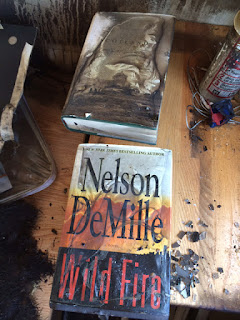
The book by the bedside!
One irony I discovered was the book I’d been reading beside our bed, named “Wild Fire” by Nelson DeMille, was half destroyed by the flames back there.

In the two months (minus four days) that followed this catastrophe, there were many days I didn’t think we would make it out the other side. We were heartened by how efficiently Progressive Insurance got on the job and totaled our car, making it easier to come up with a settlement. This allowed us to find and purchase a new (to us) Honda Fit that could be towed behind our next motorhome.

We had a wonderful counseling session with a pair of dear friends with whom we’d sailed through the Bahamas 14 years ago. Tracy and Tom provided very useful thinking about this being a crossroads moment that allows us to change direction and decide if we want to continue our current lifestyle.

We’d already considered that and had come to the conclusion that we are still passionate about living on the road and volunteering in the state park system of Florida. But it was a moment to consider, once again, if we should be replacing our motorhome with a boat so we could resume the journey on the water instead of the land. We decided to stay on the land, however, because there are more opportunities to volunteer.

One of the key ingredients to getting our lives back on track was the creation of a website by our eldest daughter, Lynn. She started a GoFundMe page in which she told our story. She asked me to fill out the financial forms for the site so she would not have to be responsible for transferring money from there to our bank account.

This is a look at our melted medicine cabinet.
Now we were blessed by receiving an influx of funds that grew from a trickle to a torrent. Every morning, I’d receive a text message from GoFundMe, informing me that $1,230 or $435 or $598 had been transmitted electronically to our checking account. 

This came from an almost countless series of lifelong friends, as well as friends of those friends. People we have never met donated to our fund in a supreme act of generosity. By the end of this, we had received more than $8,000 from kind and loving people.

Jo’s knitting friends (she tries to get together with them each Wednesday) cme through with checks and orders for her scrubbies.

You would think all of this kindness would provide us with a sense of well-being. But that fails to account for the troubles we were having every other day with the insurance company for the motorhome. We had astutely insured the motorhome for its agreed value, as opposed to its actual value. This means we did not have to deal with any negotiations regarding depreciation. Ah, but they made up for that by making life incredibly difficult when it came to a paragraph in the policy that allowed us $2,000 for living expenses after an accident. Who knew that living expenses would not include buying sheets and pillows so you can get a night’s sleep? Same for X-rays of the cat’s legs. They informed us they would pay for housing the cat – they’d even pay for housing a horse, they said – but they wanted to see every receipt for every visit to Taco Bell, or Dunkin Donuts or Macdonald’s. When we submitted every receipt for the final tally, the expenses were $1,993.20. And they paid for that.

When we first reported the claim, we were assigned a person to help us and I told him about all of the add-ons to our motorhome in the four years we’d owned it. None of those were covered, he said. So I said I wanted to remove those items from the rig and he said I was entitled to do that because these items were my property. Two months later, however, I am still unable to remove them because the insurance company has put seals on the doors because they have counter sued the manufacturer of the alternator that the fire inspector said was the source of the fire as well as the company that did the installation of the alternator.

To add just a final slice of stress to our lives, the insurance company wired our settlement to our bank but managed to transpose two numbers in our account so the money disappeared down some black banking hole for two weeks.

My nearby bank manager helped us locate the missing funds. But they had to be returned to the insurance company before they could retransmit them to the right account.

While this dance was continuing, Jo and I were on the lookout for a new motorhome. We have come to love the Alfa motorhome line, even though they are no longer being manufactured. We love the high ceilings, the quality woodworking, the basement air conditioning and lots of great design features. It’s also the devil we know versus the devil we don’t know when it comes to another manufacturer.

A series of nationwide searches turned up about five Alfas as far away as Oregon, Houston, TX, Tennessee, Fort Myers and Cocoa on Florida’s east coast. We talked with the dealer in Cocoa and, as luck would have it, he was still smarting from selling the rig to someone who was unable to get financing so he was motivated and agreed to drop the price by $10,000 to something we could consider.

We journeyed across the state and went over the rig with our fine tooth combs. We liked much of what we saw and gave the dealer a deposit. I then went online in an attempt to locate the original owner of the coach. I found his address in Livingston, TX, which meant he was a member of the Escapees motorhome group of which we also are members. I found his phone number on the internet and dialed him. In an incredible coincidence, he told me he currently was in the same town as us, Dunedin, FL, with his new motorhome. We chatted about the old rig and he provided outstanding insights about some issues we had not seen when we went through the motorhome. As a result, I was able to stipulate some required fixes that were quite costly to the dealer.

We awoke last week and I checked into my bank account to find our settlement money was finally nesting there, so off we went across the state to claim our new home. We’re back at Honeymoon Island State Park now for another two weeks. Then we begin our trek north to visit family. All seems well.

Living area, looking forward. We love the huge windows.

Monday, November 30, 2015

A Little Does a Lot

Fred in Rwanda
Each year at this time, Jo and I reach out to help one person who is looking to improve their lot in life. We work through Kiva, a group of people that acts as a go-between to locate and vet people all around the world who need just a little help to get their business up and running.

Up until this year, we have made it a policy to help women because of our experience around the world. The safest loan recipients seem to be women because they invariably will move heaven and earth to meet their commitment to pay back their loans. Men seem to give in to hopelessness more quickly and throw in the towel earlier.

But this year, we decided to take a chance with Fred of Nyagatare, Rwanda because, as luck would have it, we’d just watched a television program last Sunday morning which told about a new technology that has sprouted in Africa where people are able to transfer money instantly and safely by using their cellphones. And Fred is on the frontline using the technology.

Here is Fred’s story via Kiva:

Fred is an enthusiastic entrepreneur who wants to thrive by growing his business. His company is a mobile servicing company that offers mobile retail services to its clients. These services include money transfer, withdrawing and depositing. In addition to that, the company deals in airtime credits, electricity voucher selling and mobile technical support services.

Fred's business is located in rural Northeast Rwanda near the Uganda border. His regular clients are people from his village, but he also does a significant portion of his transactions from people crossing the border by bus. Being able to transfer money, even small amounts, from mobile phone to mobile phone is a revolutionary resource in rural areas. Often when people move to the city for better jobs and economic opportunities, they want to send money back to their families in the rural villages. Through Fred's business, he is creating an opportunity for people in the villages to receive money without having to take long bus rides or relying on other people to deliver cash.

Fred is doing very well in business. He is well-known in the community as a highly motivated entrepreneur and a reliable person. However, he is not meeting all his clients’ demand. With working capital of about $4,000 USD, Fred will be able to triple his business to meet the growing demand for his services.

African Entrepreneur Collective has been working with Fred for about six months, and he has continued to be motivated and inspiring. AEC previously gave Fred a small loan, which he paid off always on time. AEC is thrilled to help Fred with his growth plans, enabling him to support many more people in his community. Fred is very successful and has always fulfilled his payment obligations, and this time will not be different.

Jo and I, in the past, have given small loans to people like Yun for her retail business in Cambodia, Sokhoeun for construction in Cambodia, Bou and her group of farmers in Cambodia, Le for her tailoring business in Vietnam, as well as March for her vehicle in Cambodia. All these women have paid back 100 per cent of the loans they were given and all report their lives have improved in dramatic ways because of the loans.

What we like most is that our donation get used and reused many time over as these entrepreneurs pay it back and the money recycles so it can be re-loaned to another person.


If you like this idea, click on www.kiva.org

Fred lives in Nyagatare, Rwanda  in the northern corner of the country.

Tuesday, November 24, 2015

A Lesson for All of Us

A scene from the movie "Spotlight" in which editors and reporters struggle to get their arms around the pedophile priest story in the Catholic Archdiocese of Boston.

We’ve just returned from watching the new movie, “Spotlight”, which put me in mind of the “must-see” movie I carried across the world for more than a decade while I was working as a trainer/mentor of journalists in countries as diverse at Cambodia, Nepal, Bhutan, India, Malaysia, Pakistan and Namibia in Africa.

Back in the day, the story was “All the President’s Men,” about Woodward and Bernstein’s dogged reporting saga that brought down Richard Nixon. I’d have a VHS copy of the film in my briefcase and, when the time was right, I’d produce it for the instruction and entertainment of the journalists I worked with.

“Spotlight” is the new go-to movie for instruction and inspiration for tomorrow’s journalists. What a spectacular accounting of dogged journalism that uncovered the horror of twisted priests in the Boston archdiocese who ruined the lives of countless young men and women. And, as the story unfolds, you come to understand the complexity of the cover-up by the Catholic Church, as well as the difficulties faced by the team of Catholic reporters on The Boston Globe as they struggled to get their minds around the enormity of the crimes.

Back in the day, I would arrange a social evening at each of my stop-overs as I hopped around the globe, working with journalists. I’d provide the beer or soft drinks and chips and we’d watch the movie about all the president’s men.

 I’d pause the movie maybe 20 times so we could dissect the action, the ethical questions, the questions that resulted in ever-more questions, the earning of trust between sources and the reporters, the earning of trust between the reporters and their editors, the endless pressure and abuse that emanated from the highest echelons of the government.  All of that – and more – are repeated and enriched in the saga of “Spotlight”.

And it also highlights – for me, at least – how expensive it is to pay for this kind of in-depth journalism in an era of sinking-and-drowning newspapers. But our country will be the poorer if these kinds of long-term investigative reports are trimmed from the budgets of dying newspapers.


Wednesday, September 9, 2015

Marking an Anniversary


I wrote the following story at the request of the managing editor of The Namibian, a gutsy daily newspaper in the African country of Namibia. They were preparing to celebrate the 30th anniversary of the newspaper. 

Namibia is a country that sits on the southwest of Africa, between South Africa and Angola. There are 2.2 million people in this sandy, desert-filled country. The newspaper had invited me to travel there to work as a trainer/mentor. This was my first of three visits between 2001 and 2007. I spent a total of 10 months in country. Jo accompanied me for most of the months.

I sat with Oswald Shivute, The Namibian’s reporter in the north of the country, in his little tin shack that was called an office and I soon forgot my troubles in the 115 degree heat of his office. He took pains to give me a history lesson about the tribal situation in the North. The phone rang on his desk and he received a tip that the mortuary at the state hospital in Oshakati was full to overflowing with dead bodies.

He told me about this and said he would call the hospital to see if he could confirm this story. He talked with a woman at the hospital whom he called "sister" and she said there was "no problem." So he reported all of this to me. I suggested that we might want to get in my car and drive over to the mortuary to confirm there truly was no problem.

The scene is seared in my mind. We arrived at the mortuary. Oswald, in true Oshivambo fashion stood outside, knocking on the door. He called out three times, "Is everyone well within?" in Oshivambo. He explained this is tradition. I explained that we were at a mortuary and everyone inside was most surely dead. He thought this to be quite funny. 

We entered and came to the office where a tall man sat at a tall desk, looking like something out of a Dickens novel. He was writing in the book of the dead the names of the latest nine dead people. When he finished, he greeted Oswald and apologized for not leaving his book of death until the task was done.

I was introduced and they chatted in Oshivambo about the problem. Problem? Oh, yes. There certainly was a problem, the man said. He was the man who had to deal with it, not the sister in charge of the hospital. He told us he was stacking dead people like cord wood in his coolers.

Now my interest was at its peak. I asked if it would be possible to see the stacked dead. "Oh, no. I could lose my job," he said. I apologized and said we would never want that to happen. Then, he looked up to the ceiling, puzzling out a course of action. He wanted the story to be told. He wanted us to tell his story, his struggle, and his pain.

"If you said you came to the mortuary with the family of a dead person and you saw the dead when they went to retrieve the body, I could let you see this," he said with a sly smile.

Oswald and I discussed the ethics of this white lie. We decided it was okay so the man eagerly called his assistant and we entered the cold storage chamber. There, he swung open door after door. We saw and photographed the stacked dead. 

A man was on one tray, pushed in feet first. A woman lay on top of him, pushed in head first. It would be inappropriate to both have them head to head, he said.

One tray carried three children, with an infant placed under the tray. It was an astonishing sight. We photographed the dead and asked the mortuary manager why it was not possible for these people to be buried. He explained that the government no longer permitted poor people to come for their dead relatives with a blanket in which they could wrap them. They must now bring a coffin. Coffins are too expensive for most people, so the dead have piled up for six months. Now the mortuary can handle no more dead, he said.

We left the house of the dead with a great story, one which became the lead story, with pictures, in the next day's Namibian. It also became the talk of the nation on radio and eventually made it to the floor of Parliament where the ruling party was criticized for this state of affairs. The solution came about two weeks later when a mass grave was dug and the assembled dead were disposed of.

Friday, August 21, 2015

Journey's End

Lobster at the end of the trail. Made the whole journey worth it when we found these beauties for $5.99 a pound in New Hampshire.

We’re back!

Nine thousand, two hundred and five miles after we left Honeymoon Island State Park on the west coast of Florida, we have closed the circle and have returned to central Florida.

The first question I wanted to answer (for myself) related to the cost of our installation of the solar panels on the roof of our rig. Was it worth the expense? Short answer: An unqualified Yes. We spent $2,610 on the solar equipment - a 960-watt array of four solar panels.  So we had to live off the solar panels by not parking overnight in paid campgrounds. That’s fairly hard to accomplish in the eastern part of the U.S. (unless you stay in Walmart parking lots).  But it was a breeze in the West. Out there, there are millions of acres of Bureau of Land Management tracts and much of it is available to the public for free camping. Of course, you have to know which land is BLM land and which is privately owned.

But that's where our handy-dandy 840-page electronic book, Days End, came in. This remarkable document, laboriously researched and prepared by dedicated volunteers from Escapees.com, tells you every latitude and longitude for every free camping spot in all of North America. It was our most valuable possession on this trip and the $10 cost paid for itself over and over.

We were on the road five months and four days. And we paid for campgrounds on 59 nights. Cost: $1,229.19 at an average of $20.83 per night.

That leaves a whopping 93 nights where we parked free. To be fair, some of those nights were in the front and side yards at the homes of our daughters Lynn and Stephanie in Kent, Connecticut, and Colchester, Vermont. Nonetheless, our solar array provided us with the self-sufficiency and blessings of power while living under the sun. And it worked even on the cloudy days. As a result, it’s clear to me that the cost of the system has been paid for by the boon-docking camping we have done along the way. From this day forth, every night we boondock adds to the savings. Hard to beat that for cost efficiency and payback.

Everyone wants to know about mileage, it seems. Considering the wide variety of terrain, and the weight of our rig (32,000 pounds) I'm pretty happy with our mileage. We achieved 9.06 miles per gallon. In the flat lands, we averaged 9.8 miles per gallon. When I consider the momentous mountains we crawled over, sometimes managing to achieve only 28 miles per hour as we climbed and climbed, I'm actually quite surprised that we got 9.06 mpg.

Repairs along the route are a sad and painful story, however. They far exceeded any budgeted amount we had set aside. Our repair bill exceeded $8,940. Half of that came from an unscrupulous shyster repair shop in Rock Springs, Wyoming, where we were relieved of $4,300 for repairs that were poorly performed and which resulted in a near-catastrophe 92 miles after we left his repair shop. Because his mechanics had improperly installed a new fuel pump, the installation failed spectacularly when we drove across Wyoming. This resulted in an O-ring disintegrating and 19 quarts of engine oil sprayed out of our engine, coating the rear of our motorhome, as well as the Honda Fit we tow behind the rig. We were very fortunate that the engine did not seize up from lack of oil. Because of the good work of an emergency repairman who replaced three damaged O rings, we were on the road the next morning, licking our wounds.

And the final outrage came when the original repair shop owner refused to compensate us for the repairs we required. He actually had the unmitigated nerve to tell me his original $4,300 repair bill was grossly inaccurate and he would only pay my new $490 bill if I would kindly send him a check for an additional $3,000 because his staff had under billed me.

Add to this horror story, the blowout of a front tire, $868 to replace it, on the highway. Then our bank of batteries died while we were camping in the wilderness and that came close to $1,000 for replacements. And, finally, we had scheduled maintenance performed that came in at $1,820. So this was a very expensive part of our journey.

But, in the final analysis, this trip was not about the dollars and cents. It was a voyage of exploration and discovery. The proud Navajo and Hopi people, the soaring majesty of our mountainous west, the mammoths discovered in the swamps at Waco, Texas, the dinosaur bones embedded in the mountains that used to be at sea level two or three million years ago in Colorado. We’ll treasure the memories and photographs of standing 272 feet below sea level in Death Valley, or driving ever-upward through a mountain pass, 9,144 feet high, with sleet and snow all around us. Scary…but oh so rewarding when the crisis is over and you slip down the mountain into the verdant valley below.
Jo rests at the Cone mansion in the mountains of North Carolina while a storm rolls in from the north.
We’ve enjoyed having our friends participate in much of this ride and hope you gained some worthwhile insights into the people and places along the way.