Friday, February 20, 2015

All Power to the Sun

Louie screws the cables into the roof in front of two of the solar panels.

We have, at long last, made the move to solar power aboard our motorhome. It’s been two years of planning and learning. But the install is over now and we're amazed at how well this is working.

Yesterday, our first day back at Honeymoon Island State Park, we unplugged from shore power. I switched on the 2400-watt inverter that’s built into our motorhome. Voila! Everything lit up and we continued as normal. The crockpot continued to cook away, the lights continued to work. The TV functioned as it usually does.

We have a handy-dandy meter built into the front of our rig now. Its task is to measure the demand on the electrical system and it also measures the solar panels on the roof and their ability to meet that demand. If they are not able to meet the demand, the meter tells me I’m in negative mode and the power I need is pulled from the six 6-volt batteries I have at the front of the motorhome. If demand is being met by the sun, the meter tells me that, too, and the power simply passes from the solar panels to the control unit, then to the batteries and back through the inverter.

I can flip through the various screens and see all kinds of information about what’s happening in the batteries. All day, I was pretty much glued to this meter to see cause and effect. When I turned on the microwave oven, for example, the power demand was very high. The microwave demanded 90 amps from the solar panels. And the panels silently met that demand because we had clear skies all day. Later in the day, I plugged in the kettle to make tea. The meter showed that I was demanding 72.5 amps from the solar panels. And they delivered.

Our system has the ability to deliver 960 watts of power at a maximum of 160 amps. It was heartening, even exciting, to see how well the sun met our needs as if by magic.
When I flipped the switch to turn on the electric water heater, however, nothing changed on the meter. That told me, immediately, that the inverter has not been wired to allow the hot water tank to be used through the inverter. We have a nifty work-around for that, however. The hot water heater can be powered by electricity or by propane gas when you are camping away from electricity. Likewise, the refrigerator does not use the inverter to make 110 volts of AC to run that. Instead, its brain knows when it is not plugged into shore power that it should switch automatically to propane for its source of power.

There are four solar panels on the roof of our coach. Each one is designed to produce 240 watts of power. All of these are tied together and then the wires come together in a combiner box at the front of our coach. This is where a pair of heavy-duty wires come through the roof and was snaked down the frame of the coach alongside the windshield. They then were routed to a compartment under the driver where they are plugged into a solar controller. This is the device that is super smart and is able to understand what’s coming in from the solar panels and then it converts all this raw energy into 12-volt power that is usable by the batteries and the inverter in the coach. Lots of wiring, to make all of this work. It was ‘way beyond my electrical knowledge or comfort zone. 

That’s where Hotwire Enterprises came in. They are located 12 miles north of us in the little Greek town of Tarpon Springs. John Gambill, a retired sailor, runs the place and he was the brain behind making this wiring work.

He subcontracted much of the electrical work out to Louie, a marine electrician, who is a master of 12-volt systems. Louie is a transplanted New Yorker who is a master craftsman. He was fastidious and careful about every connection and every wire.

Now, we will test out our six batteries in the next few weeks to see that they are up to handling the activity. We think the batteries might be original to the 10-year-old coach so it is possible we’ll have to install new ones if they don’t have the necessary holding power. In the meantime, watching my meter is more fun than watching TV!


The dash of the motorhome can be lifted to allow access to all of the fuses.

Tuesday, December 9, 2014

Coming to America...Today

The Cubans were landing as I came along the beach and I got to be the first American to welcome them to these shores.

The time was 7:36 a.m. I’d just met Tony, the new Park Manager, on his first day at Fort Zachary Taylor. I came around the bathhouse at the concession stand and the sun had just cracked above the horizon. Good mood. Wonderful new day.

And, because I was happy, I was playing my music on my iPhone. Neil Diamond was singing. And I was singing along:

“Everywhere around the world
They’re coming to America.

Got a dream to take them there
They’re coming to America
Every time that flag’s unfurled
They’re coming to America.

Got a dream to take them there
They’re coming to America
Got a dream they’ve come to share
They’re coming to America

Today. Today. Today. Today. Today.

And there they were. Fifteen young Cubans had just leaped from their homemade boat into the surf off our swimming beach, under the coconut palms. They were almost delirious with excitement.  

They hugged each other and screamed “Libre. Libre” to me as I got on my walkie-talkie to call the administration. “I have 15 Cubans who just landed on our beach. I’m heading toward them,” I told Jayne, the assistant park manager.

I walked over to the Cubans and shook their hands, smiling and saying, “Welcome to America.” They were cold and wet for the morning temperature was only 63. But they all looked healthy. And they were VERY happy. I so wished I had either of my old buddies, Jose Azel or Celia McTague Pomerantz with me to help me communicate. Jose was born in Cuba and Celia has a Puerto Rican heart of gold.

The park staff arrived by then and we all stood around, handing out our supply of shop towels. Those are the beach towels we store after visitors leave them on the beach at the end of their day.

One of the Cubans opened his wallet and began handing me 10, 20 and 50 peso bills. He pointed to the pictures on the different denominations and said, “Jose Marti” and “Maximo Gomez” and “Antonio Maceo” and “Fidel Castro” on the 20 peso bill. I passed the money back but he pushed it on me again. Then they began to tear the bills into little pieces, indicating they were worthless.

The Key West Police soon were on the scene and they were exceedingly kind to the young people. They asked in Spanish if they were hurt, hungry or sick. But no one was. I learned later, however, three of the girls were taken to hospital because they had diesel fuel spilled on their bodies.

One young girl, maybe 18 or 19, carried a wooden bowl. I asked to look inside and she removed the lid. Inside were dry beans and beads. A Key West policeman told me it was probably Santeria, the Haitian-Cuban-West African animist religion.

The police suggested they move over to the bathhouse so they’d be out of the wind so this is where I left them.

I spent the rest of my shift explaining the latest landing to our park visitors.  The boat was better built than last week’s version, which was basically Styrofoam with a couple of areas of sheet metal. It also had a diesel engine inside, along with jugs of fuel and water. We found hypodermic needles and bags of saline solution in addition to Dramamine and some other anti-nausea pills aboard the boat.  All the visitors were in awe that these young people risked all to make the 90-mile voyage to our version of freedom.

All in all, this was a very good day to be at the park.

Refugees gleefully push Cuban pesos on me because I welcomed them ashore.

Monday, November 17, 2014

Meeting with Don, the Parolee

Two schooners, one built of wood (foreground), the other of steel, duel for position in the channel off Key West.

I want to tell you the best part of my volunteer job. It’s interacting with the visitors. This morning was a perfect example. I met Don, a 64-year-old guy who is on parole. We didn’t get into his crime or misdemeanor. But I got just about every other aspect of his life.

Don was waiting at the park for his bank to open at 9 a.m. He comes to the park each day, he told me, because it’s a great place to hang out. He meets with Dot, his parole office once a week and she is a peach, he said. He’s known her for 34 years. I don’t know if that’s because Don is a pain in the ass felon who keeps getting into trouble. Or maybe he knew Dot in another life, somehow. Anyway, Dot basically wants to know what he’s up to, what he’s been doing, and what his plans are for the coming week.

Now, let’s go back to the bank. He said he went to the ATM machine last night to get $20 cash and the machine rejected his request. It said he had insufficient funds in his account. But that can’t be, Don said. He had $220 in there the day before. I said it sounds like the bank auto-paid a bill that came due.

And that started a new train of thought. Don told me he is on Social Security disability and gets $664 a month from the government. His room in Key West costs his $600 a month. I said that doesn’t leave much for food and he told me the state comes through with $134.23 for Food Stamps. Still sounded kind of thin to me.

But I noticed he had one earpiece plugged into his ear and the other end of it was plugged into an iPhone. “That ain’t cheap,” I told him…and he agreed. That costs him another $82.25 a month.  I don’t see how it all adds up, I told him.

Anyway, he couldn’t explain the gap between income and outgo, so I decided to drop the subject. 

But Don was still my most interesting character of the morning. And he was a lot more interesting to talk to than my usual conversation with mourning doves and palm sparrows who greet me on the picnic tables and who absolutely refuse to move while I reach around them to pick up cigarette butts with my Pik-A-Stik.

I’m in awe, by the way, at the endless supply of cigarette butts that accumulate each day in the park. Siri tells me that 23 per cent of Americans still smoke. Back in 1950, she tells me, 50 per cent of the population smoked. If I’d been picking up butts back then, I’d be hip deep in them!

Friday, September 26, 2014

We've Gone To Extremes Again


I’m not an extremist – not in any real sense of that word. But there is something in my soul that demands that I go to the extreme corners of our country - and even the earth. Don’t know why. But I just have this insatiable craving to go to the extreme northwest, the extreme northeast, etc.

We’ve accomplished this goal by making it to Anchor Point in Alaska – as far to the northwest in North America as it is possible to reach without leaving the roads. And we have touched the most easterly point in North America by reaching freezing Cape Spear in Newfoundland. And that doesn't even count the high Himalaya of Bhutan, or the sweltering jungles of Borneo or the dry desert of Namibia.

Today, we parked our home at the most extreme southeast corner of the country. We made it to Fort Zachary Taylor State Park in Key West, Florida. This feat involved a sensuous drive along a glittering pearl and diamond necklace of keys for more than 100 miles. The journey took us over a ribbon of highway that allowed us to drive, effectively, across the ocean.

We left Key Largo at the northern end of this highway and wandered southwest on a two-lane road that took us to the jewels of the Florida Keys: Plantation, Matacumbe, Lignumvitae, Hawks, Fat Deer, Boot, Big Pine, Cudjoe, Sugarloaf, Rockland, Boca Chica and, finally, Key West.

These keys are connected by impressive bridges, some running seven miles across the sparkling ocean. The shades of blue and green on this water stretches my ability to describe them. Sapphire, of course, and that gave way to cobalt in the deep blue water holes. Then there is Cerulean, Azure, Aqua, Amethyst, even Robin-egg Blue. The palette is exquisite and the miles slip away easily and painlessly as we catch our breath with the pure pleasure of the ceaseless sea.

We arrived at Fort Zachary Taylor at high noon and were greeted by park rangers and volunteers alike. Because we are a few days early, they had to find a place for us to park until we can slip into our home for the next three months. That was easier said than done. We maneuvered among the palm trees and gumbo limbo trees. It was too close for comfort and I eventually backed out and parked the rig beside a ranger’s house. We plugged in and settled down to our new adventure.

First things first: we unmounted our bicycles from the back of the rig, pumped up the tires and took off to view the park. A high-sided boat was perched at the entrance to our quarters. Another volunteer told me this had arrived a few nights before from Cuba with about 20 refugees. They had filled it with fuel and water, started the 12-cylinder diesel engine and high-tailed it out of Cuba. All the men jumped ashore and immediately stripped off their Cuban Army greens, swapping the clothes for tee-shirts and khaki pants. The army greens were found on the beach later in the night. 

We in the U.S. have this peculiar policy that is exclusive to Cubans. It’s called the wet-foot-dry-foot policy. If the Cubans make it to shore in the U.S., they are given $10,000 and welcomed as refugees. If, on the other hand, the Coast Guard spots their boat and stops them before they can put their foot on American soil, they are handed back to the Cuban government unless they can prove that returning to Cuba will result in their death.

So these characters made it through the net and are winners.

Well, enough of this for the time being. We look forward to an adventurous time in this most southern point in the mainland U.S.
 
The signpost on our beach lets you know how far away we are from Tokyo, Cancun, Paris, Habana, London, and even Miami.

Monday, August 18, 2014

Man Down. Man Down

My time came today. I was climbing to the top of the Cape Hatteras Lighthouse at 12:30 p.m. I reached the halfway point and took the walkie-talkie radio from Ranger Kelly. I was carrying a book, along with my water jug and I continued onward. I noticed I was feeling the oppressive heat inside the lighthouse and took more rests than usual. There are 257 steps to the top but there are landings every 31 steps. There’s a window on each landing and I stopped at landing six for a breather.

I pushed on to landing seven where I found I was unusually out of breath. So I stopped again. Now I was sweating profusely. I put my book down on the window sill and took a swig of my water. But still I felt a little light-headed. I thought to myself: just push on one more flight of stairs. You’ll be better when you reach the top because there’ll be more breeze up there.

But then I slid down the wall, every-so-gently, and lay on the floor of the landing.
I remember a man in a blue shirt leaning down looking at me and asking if I was okay. I said I felt a little shaky. He grabbed my radio and transmitted, “Man down. Man down.” Ranger Justin, on the balcony, talked to him on the radio to figure out where the transmission was coming from. 

The man in the blue shirt told Justin we were one floor down from the top and Justin ran down the stairs to get to me.

The man in the blue shirt explained to Justin and me that he was a First Responder from New Jersey, that he had been at the World Trade Tower on Sept. 11, 2001. He said he had my pulse and it was shallow, that my skin was clammy.

Justin went through his procedure for a man down. He asked if I could move and I told him I actually felt a bit better, that I thought I would do even better if I went up one flight of stairs to the top and got fresh air because of the heat in the tower. He brought a cold compress with him and he put that behind my neck. He had already called Jason, the head ranger, who ordered the lighthouse closed, with all climbers below us to be evacuated. Those above us were asked to stay on the balcony. 

I climbed the last flight up to the balcony but I felt pretty shaky when I arrived there. Down I went again. It was a gentle collapse…just rubber legs that could no longer support me. I don’t believe I passed out.  But Justin confirmed I had, in fact, passed out. I do remember hearing Jo’s voice coming over the radio. She was assigned at the base of the tower. “Could I have a status report on Robert,” she said. Justin got on the radio and told her I was down but was speaking to him. He told her he had summoned the EMTs and we could actually hear the sirens as he spoke.

The man in the blue shirt stayed with me and I told him I was honored that he was there with me.

A woman supported my back with her legs on the balcony and held her hand over my eyes so the sun wouldn’t be too bright. Jason arrived, huffing and puffing a bit too much and I apologized to him for causing such a scene. And, minutes later, the first of two EMTs came on the balcony. They took my blood pressure and it was quite low (92/72) and a discussion started with Jason about whether they should use the box stretcher to carry me down. I told everyone I planned to walk down on my own, however. I asked if I could move around the tower so I could get in its shadow from the burning sun. Eager hands helped me to my feet and I walked the few feet to the shade. The woman who had been supporting me and shading my eyes showed me the imprint I had made on her two legs and I apologized. Jason said my color was coming back from the chalk white I was when he arrived on the top.

I told the EMTs that I’m a week away from the third anniversary of my heart attack but I had no sense this was related. I felt my blood sugar might be too low because I hadn’t remembered to take along my mid-morning Trail Mix snack bar today which I always do when I have a late lunch scheduled.

After I lay there for at least 10 minutes, I said I was ready to hike down the tower. One of the EMTs took the lead, with another one right behind me. It’s pretty easy going down and when I left the lighthouse, I was greeted by a smattering of applause.

The EMTs took me to one of three ambulances they had brought to the scene (!) and I climbed in. They placed me on the gurney, took my blood pressure again (115/80), pulse, and blood sugar (157) and then, just to be sure, hooked me up to the EKG monitor and took a look at my heart. The printout was as pretty as they come and they complimented me on what was happening in my heart. The lead technician said it looked a lot better than his. Jo had joined us in the ambulance and the EMTs said they felt I had been overcome by the heat. They offered to transport me to the nearest hospital – an hour away – for further tests but I said I thought that was unnecessary.

So they discharged me. We joined Jason in the Principal Lighthouse-keeper’s Cottage and he said he wanted us to take the rest of the day off. He also said he’d work on getting us a break at 11:30 each morning so I could rehydrate and stop for a morning snack.


Friday, August 8, 2014

A Tale of the Sea


I occasionally have a free hour in my schedule and I visit the Cape Hatteras National Seashore library to vacuum it for interesting stories. This is considered to be my research time. I recently came upon an outstanding book called Diving the Graveyard of the Atlantic by Roderick M. Farb. It’s full of great yarns about the sinking of ships.

The Outer Banks of North Carolina holds the bones of thousands of ships, hence the superior lighthouses that act as a pearl necklace long the coast. What I didn’t realize, however, is the story of German U-boats that ranged along this coast in 1942. While I was an infant of three or four, I remember my dad’s task during the war of being an Air Raid Precaution officer in Inverness, Scotland. His job required him to walk the streets of our neighborhood at night to check there were no chinks of light escaping from the houses. And he, being a stickler for detail, would bang on the door if he found someone who had sloppily left a blanket askew on a window.

But over here, along the Atlantic seaboard, Americans initially were oblivious to this need to block out the light and, it turns out German U-boats took full advantage of this “it can’t happen to us” attitude. They formed wolf packs of subs off the Outer Banks and in the first three months of the war, U-boats attacked and sank 70 U.S. tankers, freighters and other assorted ships. Astonishingly, the U.S. Navy was so ill-prepared for these attacks that it took the U.S. three months to get its act together, snub out the shore lights, the navigation buoys and, yes, even the lighthouses.

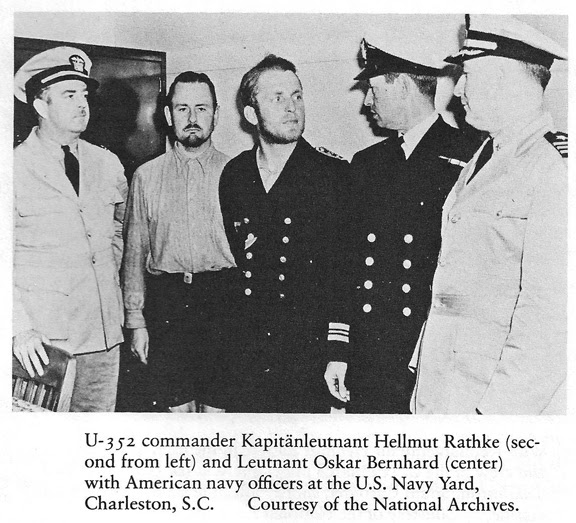
In Diving the Graveyard of the Atlantic, Farb tells the story of  U-boat 352 and the U.S. Coast Guard cutter Icarus. When they met, no help came to either of them. The battle was a fight to the finish. Today the loser sits on a sandy bottom, 115 feet deep, 20 miles off Morehead City, North Carolina.

U-boat 352, captained by Kapitanleutenant Hellmut Rathke edged out of St. Nazaire harbor in France on the morning of April 4, 1942. An East Prussian by birth, Rathke was 32 years old and considered a rising star in the U-boat arm of the German navy.

Meanwhile, up in Staten Island, N.Y., the U.S. Coast Guard cutter Icarus, commanded by Lt. Maurice D. Jester, received orders to proceed south to Key West, Florida.  As it cleared the harbor in New York, a passing tug signaled G-O-O-D-L-U-C-K. Icarus signalman flashed back T-H-A-N-K-S-W-E-W-I-L-L-D-O-O-K.

They were destined to meet off the Outer Banks on May 9. Rathke had spent many hours training his raw crew on crash dives and other maneuvers as they slowly crossed the Atlantic. He allowed his crew time to sunbathe on the deck of the sub but he also ran drills to get them in shape on their first expedition to the coast of North America.

When Rathke arrived offshore, he would sit his U-boat on the bottom during the day and then he’d bring the sub to the surface in the dark. He’d allow the radioman to tune in U.S, radio stations that were transmitting jazz music for the entertainment of the crew. He tried several times to take out ships but his torpedoes went wide. He was bombed by a vigilant plane but managed to escape damage.

Finally, late on May 9, he watched a single mast rise above the horizon. Rathke ordered a crash dive and maneuvered toward the sighting. He ordered one and two torpedoes flooded. They were loaded with electric torpedoes of the latest design. He fired in quick succession. Lt. Ernst, the U-boat’s No. 2 officer, adjusted the submarine’s trim but the adjustment was too severe and Rathke lost sight of his target.

Suddenly the U-boat shook from the recoil of a distant explosion. Rathke ordered the U-boat brought up to periscope depth so he could observe the target. He believed it was a small freighter. It was, however, the U.S. Coast Guard cutter Icarus.

What he didn’t know  was that his torpedoes had actually ploughed into the sand close to Icarus and had exploded. Icarus was jarred but was fully operational. She swung around and headed directly for the sound pattern the radioman had identified as U-352. 

The submarine crew cringed as Icarus came overhead. The first depth charge exploded next to U-352’s deck gun. Another went off beside the engine room. Two charges drifted down alongside the conning tower. Icarus trembled under the impact as these depth charges exploded.

Aboard U-352, every gauge exploded and shards of glass flew everywhere. Lt. Ernst was flung into the control panel, crushing his skull. Lights flickered throughout the U-boat and then died.

Both electric motors aboard the sub were wrenched from their mountings and the boat was without power. One motor could run intermittently.

Rathke analyzed his situation. His No. 2 officer was dead. He was limping, without instruments and only a small amount of power in one engine. But he refused to give up the ship. What he didn’t know was that a large amount of sheet metal on the bridge had been blown away and the buoyancy of his vessel was questionable.

The radiomen aboard Icarus tracked the sub and knew he was trying to slip away but Lt. Jester brought Icarus around for a second attack.  U-352 was about to be a dead boat.

Rathke ordered silence and every man stood absolutely still. The only sound was a drip from the No. 1 torpedo tube. When it became a spurt of water, one of the torpedomen cried out. Rathke sent a man forward to demand silence.

No depth charges had fallen in 15 minutes. The Icarus’ engines died away and then returned, ominously strong.

The new round of depth charges knocked U-352 on her side and she settled on the bottom, one of her buoyancy tanks was ruptured.

The first man out of the sub had his right leg blown off by a machine-gunner aboard Icarus. The three-inch gun aboard Icarus was punching out as long and hard as it could go.

As the Germans escaped from their sunken sub, Rathke spotted his machinist who had his leg blown away. He was in a sea of blood. The captain removed his belt and tried to staunch the flow of blood from the severed leg while the hail of gunfire continued around him.

Rathke called for his men to have courage as the hail of bullets continued from Icarus. Helplessly, he watched them being shot to death in the water. Rathke shouted for mercy and for help and his men joined him.

John Bruce, aboard Icarus remembered seeing the men in the water. He screamed, “For God’s sake, don’t shoot them in the water.” But he was derided by his fellow crewmen. One of the men said, “That could have been us.”

The gunners on the stern stopped but the gunners on the bow maintained their firing. Three minutes after U-352 went down, a runner from the bridge went to each gun and ordered a ceasefire.

After one more round of dropping depth charges on the sunken U-boat, the Icarus headed away from the scene. Lt. Jester was unsure of his authority and didn’t know if he had to do anything other than sink submarines.

He sent a message to Norfolk, stating he had 30-40 men in the water and asked if he should pick them up. There was no reply.’

Next he tried Charleston and still there was no reply. The message was received and acknowledged.

After 10 minutes, the radioman asked if Charleston had any message for Icarus. The answer came back: “No.”

The radioman saw that Icarus was pulling farther and farther away from the U-boat and he went up the chain of command asking again if  Icarus should pick up survivors.  After 40 minutes, he asked again. This time, he received a coded message authorizing the pickup of the U-boat crew along with orders to take them into Charleston.

Rathke saw Icarus returning and he gathered his crew around him. He told them: “Remember your duty. Do not tell the enemy anything.”

Rathke asked that his wounded men be taken aboard first. Rathke was the last man out of the water. Fourteen of his crewmen died in the engagement. It was the first U-boat to be sunk by the U.S. in World War II by the U.S. Coast Guard.
When you dive on U-352 today, there's lots to see, even after 72 years.

Saturday, August 2, 2014

An Almost-forgotten Past

A female Coast Guard person is "rescued" by the Breeches Buoy at Chicamacomico.

Before the U.S. Coast Guard, we had the U.S. Life Saving Service. These guys lived on the Outer Banks in the 1870s in life saving stations scattered along the shore. Their task was to brave the elements and attempt to rescue the survivors of the 2,200 vessels that ran aground on these shoal waters off the east coast.

Jo and I were assigned to visit one of the lifesaving stations that now are registered as a Historic Place. We visited Chicamacomico (pronounced CHICA-MA-COM-ICO), which, to the Algonquian-speaking peoples means “land of shifting sands”. Those Indians knew whereof they spoke. The sands do nothing but shift.

The Coast Guard from the Hatteras Station had come north to the station to put on a demonstration of how the life-saving team would launch a Breeches Buoy from the land to an object representing a foundering ship.  Their spokesman told us the service back in the 1870s would be tested on a regular basis to be sure they were capable of performing the exercise in five minutes.  

The brawny Coast Guard men and women took around 25 minutes to perform the task of digging a hole in the sand in which they anchored the equipment. They then lined up their brass cannon on a replica of a ship’s mast and fired the cannon. They missed the mast because the wind dropped at the moment of firing and the shot went wide.

We watched as they tied off the rope to the mast, cranked in on a pulley system to make a tight connection to the shore and then sent the breeches buoy out to the “ship” and rescued the youngest and lightest of the Coast Guard women.

There were 29 stations strung out along the Outer Banks of North Carolina. And their record of rescue is pretty impressive. We were told more than 177,000 people’s lives were saved by the crews. The most notable rescue occurred in 1918, toward the end of World War I when the men of the Chicamacomico station rescued 42 of 51 sailors aboard the S.S. Mirlo after she was sunk by a German submarine.

Very few lifesaving stations remain in the U.S. today. So, should you come to the Outer Banks, this is a “must visit” site.
Jo walks toward the life saving station as a Coast Guardsman steps down the ramp.